Breaking the Forking Trap: How Meta Built a Future-Proof WebRTC Architecture
Introduction
In the world of real-time communication (RTC), WebRTC is the open-source backbone that powers audio and video calls across countless applications. At Meta, WebRTC underpins everything from Messenger and Instagram video chats to low-latency cloud gaming and VR casting on Meta Quest. But as Meta scaled to serve billions of users, a common industry problem emerged: the forking trap. Permanently diverging from upstream WebRTC provided short-term flexibility but eventually created a maintenance nightmare. This article explains how Meta escaped that trap by building a modular, continuously upgraded architecture that now supports over 50 use cases, all while safely A/B testing each new upstream release.
The Forking Trap: A Familiar Challenge
When a large project like WebRTC is forked, it often starts with good intentions: a quick bug fix, a performance optimization, or a feature that doesn't yet exist upstream. Over time, however, the fork accumulates internal customizations. Meanwhile, the upstream community continues to evolve—adding security patches, improving performance, and fixing bugs. Merging those upstream changes back into the fork becomes increasingly costly. The effort required to resolve conflicts and maintain compatibility can become prohibitive, leaving the organization stuck on an outdated version. Meta faced exactly this scenario with its specialized WebRTC fork, which had drifted significantly from upstream.
The Challenge: Upgrading Without Breaking Billions of Users
Upgrading a library like WebRTC is inherently risky, especially when it serves billions of users across diverse devices, networks, and operating systems. A one-time upgrade could introduce regressions that are difficult to roll back, potentially degrading user experience. To mitigate this risk, Meta needed a way to test new versions of WebRTC against the legacy version within the same application. That meant dynamically switching users between the two versions to verify correctness and performance—without requiring separate builds or complex deployment pipelines.
However, a major technical hurdle stood in the way: the Meta codebase is a monorepo, and the application build graph imposed strict constraints on binary size. The team decided to statically link both versions of WebRTC into the same binary. But that violates the C++ One Definition Rule (ODR), causing thousands of symbol collisions. A novel solution was required to make two versions of the same library coexist peacefully in the same address space.
The Solution: A Dual-Stack Architecture with A/B Testing
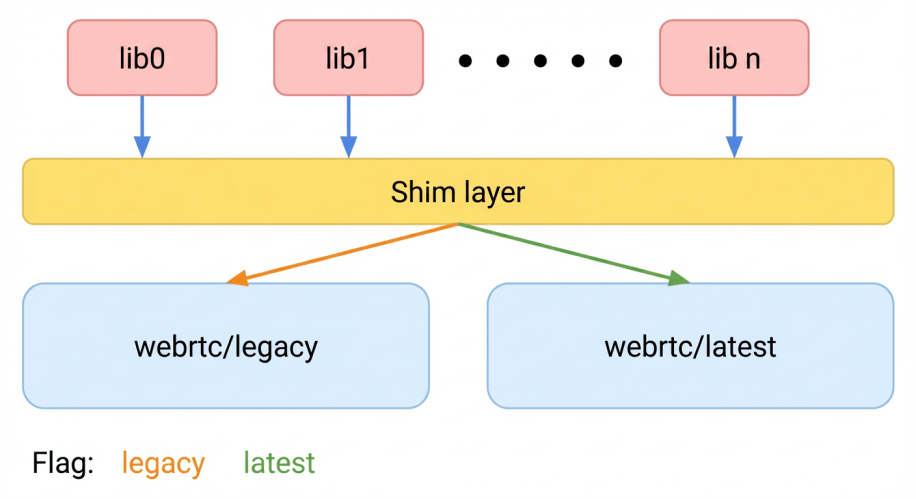
Meta engineers designed a dual-stack architecture that allows two independent WebRTC implementations to live side by side within a single library. This architecture uses a thin abstraction layer that maps internal API calls to either the legacy fork or the new upstream version, depending on the user's assigned experiment group. By doing this, Meta could run safe A/B tests across all 50+ use cases—including Messenger calls, Instagram live streams, and cloud gaming—without requiring a full rollout.
Overcoming the One Definition Rule
To solve the symbol collision problem, the team employed a combination of namespace isolation, manual renaming of exported symbols, and careful use of linker flags. They wrapped each version of WebRTC in its own namespace and modified the build system to avoid conflicts. This required significant effort but ultimately enabled the two versions to coexist statically. The result was a single binary that contained both the old and new WebRTC libraries, with a runtime switch that determined which one to use for each connection.
Continuous Upgrade Workflow
With the dual-stack foundation in place, Meta established a repeatable workflow for integrating new upstream releases. Instead of a painful merge, they now periodically rebase their internal modifications on top of the latest upstream WebRTC, then run the entire A/B test suite against the old and new versions. This constant validation ensures that regressions are caught early and that the transition to a new version is smooth. The process has been used to upgrade WebRTC multiple times, always with the safety net of A/B testing.
Results: Performance, Size, and Security Gains
The migration from the divergent fork to the modular upstream-based architecture yielded significant improvements. Performance increased due to adopting upstream optimizations, binary size was reduced by removing redundant code, and security was strengthened because the team could now apply upstream patches quickly. Importantly, the dual-stack approach didn't just solve the forking trap—it gave Meta a future-proof upgrade path. Today, every new upstream WebRTC release is A/B tested before being rolled out, ensuring that billions of users continue to receive a high-quality real-time communication experience.
Conclusion: Escaping the Trap for Good
Meta's journey with WebRTC shows that the forking trap is not inevitable. By investing in a dual-stack architecture, solving the ODR challenge, and establishing a continuous upgrade workflow, the company transformed a maintenance burden into a strategic advantage. The techniques used—namespace isolation, runtime A/B switching, and incremental integration—are applicable to any large open-source project that an organization needs to customize. The result is a more agile, secure, and performant platform that can evolve alongside its upstream community. For engineers facing similar challenges, Meta's approach offers a clear path out of the fork and into a modular, testable future.
Related Articles
- From Stills to Motion: Diffusion Models Achieve Video Generation Milestone
- GitHub Faces Reliability Crisis Amid Explosive AI-Driven Development Growth
- How to Nominate a Fedora Community Champion: Mentor and Contributor Recognition 2026 Guide
- 10 Game-Changing Features in k6 2.0 You Need to Know
- How GitHub Uses Continuous AI to Make Accessibility Feedback Actionable
- Rust Project Welcomes 13 Accepted Google Summer of Code Proposals Amid Record 96 Submissions and AI-Generated Proposal Challenges
- Enhancing Deployment Reliability at GitHub: Using eBPF to Break Circular Dependencies
- How to Get Selected for Google Summer of Code: A Rust Project Case Study