Hermes Agent: Self-Improving AI on Local Hardware with NVIDIA RTX and DGX Spark
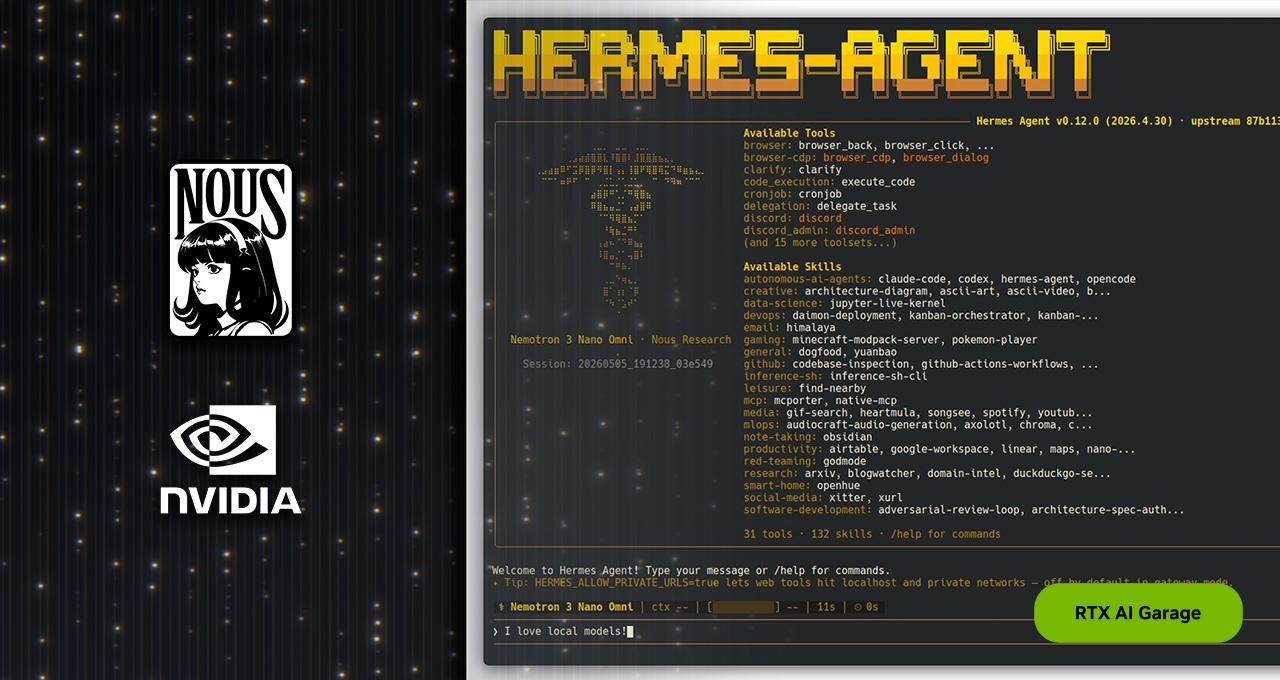
Agentic AI is transforming productivity by enabling autonomous task execution. The latest breakthrough is Hermes Agent, an open-source framework developed by Nous Research that has rapidly become the most-used agent on OpenRouter. With over 140,000 GitHub stars in under three months, Hermes is redefining what local AI agents can achieve. Designed for reliability and continuous self-improvement, it runs optimally on NVIDIA RTX PCs, RTX PRO workstations, and DGX Spark, making high-performance local AI accessible to everyone.
The Rise of Hermes Agent
Following the success of earlier open-source frameworks like OpenClaw, the AI community has eagerly adopted Hermes Agent. Its rapid adoption—crossing 140,000 GitHub stars and topping OpenRouter's usage rankings—underscores a growing demand for agentic AI that is both powerful and trustworthy. Unlike many agents that require constant debugging or cloud dependencies, Hermes is provider- and model-agnostic, optimized for always-on local use. This makes it ideal for users who value privacy, low latency, and offline capability.
Key Capabilities That Set Hermes Apart
While Hermes integrates with messaging apps, local files, and applications like other popular agents, four standout features make it unique:
Self-Evolving Skills
Hermes writes and refines its own skills over time. When faced with a complex task or receiving user feedback, it saves the learning as a new skill. This adaptive mechanism allows the agent to continuously improve without manual intervention, ensuring it becomes more efficient and accurate with each interaction.
Contained Sub-Agents
Instead of managing a monolithic context, Hermes spawns short-lived, isolated sub-agents for each sub-task. These workers have focused contexts and dedicated tools, preventing confusion and keeping task organization tidy. This design also enables Hermes to operate with smaller context windows—a critical advantage for running on local models with limited memory.
Reliability by Design
Nous Research curates and stress-tests every skill, tool, and plug-in that ships with Hermes. The result: Hermes works reliably even with 30-billion-parameter local models, eliminating the constant debugging that plagues many other agent frameworks. Users can trust that the agent will execute tasks correctly out of the box.

Same Model, Better Results
Developer comparisons using identical models across different frameworks consistently show Hermes outperforming competitors. This is because Hermes is an active orchestration layer, not just a thin wrapper. It enables persistent, on-device agents that learn and adapt, rather than single-use task executions.
Optimal Hardware for Local Agentic AI
Both the Hermes agent and its underlying large language models are designed for local execution. The quality of the user experience directly depends on the hardware. NVIDIA RTX GPUs are purpose-built for these workloads, providing the memory bandwidth and compute power needed for real-time agent inference. NVIDIA RTX PCs and RTX PRO workstations offer scalable performance for everyday users, while NVIDIA DGX Spark delivers data-center-level acceleration in a compact form factor, enabling 24/7 operation at full speed.
Qwen 3.6: Powering Local Agents
Alibaba's new Qwen 3.6 series of large language models is ideal for running Hermes locally. The Qwen 3.6 27B and 35B parameter models outperform their previous-generation 120B and 400B counterparts while requiring significantly less memory. The 35B model, for instance, runs on roughly 20GB of memory and surpasses models that needed over 70GB. This efficiency, combined with acceleration on NVIDIA RTX and DGX Spark, allows users to run sophisticated local agents without sacrificing performance.
With Hermes Agent and Qwen 3.6, the vision of self-improving, reliable, and private AI agents is now a practical reality. As the community continues to innovate, local agentic AI is poised to become a mainstream tool for both personal and professional productivity.
Related Articles
- Turning Accessibility Feedback into Action: A Step-by-Step Guide to Building an AI-Powered Inclusion Workflow
- Rust Project Joins Outreachy 2026: Four Interns Selected for Open Source Mentorship
- PHP Project Abandons Custom License, Adopts Industry-Standard BSD 3-Clause
- 10 Key Insights into Diffusion Models for Video Generation
- GitHub Copilot Individual Plans: 5 Key Changes and What They Mean for You
- Global Age Assurance Push Risks Crippling Open Source Innovation, Developers Warn
- From Stills to Motion: A Comprehensive Guide to Diffusion Models for Video Generation
- Enhancing Git Documentation: A Data Model and Reader-Driven Improvements