A Developer's Guide to Meta's Enhanced Secure Backup Infrastructure
Overview
End-to-end encrypted backups protect your message history from unauthorized access—even from Meta, cloud providers, or third parties. At the core of this protection is Meta's HSM-based Backup Key Vault, a system that stores recovery codes in tamper-resistant hardware security modules (HSMs). This guide walks you through the recent improvements to that infrastructure: over-the-air fleet key distribution for Messenger and a commitment to publishing verifiable evidence of secure fleet deployments. By the end, you'll understand how these changes strengthen user privacy and how you can verify the system's integrity yourself.

Prerequisites
- Familiarity with basic cryptographic concepts (public/private keys, encryption, signatures).
- Understanding of hardware security modules (HSMs) and their role in key management.
- Awareness of WhatsApp and Messenger backup features (optional but helpful).
- Ability to follow command-line examples for verification (e.g., using OpenSSL or similar tools).
Step-by-Step Guide: Strengthening End-to-End Encrypted Backups with Meta's HSM Vault
1. Understanding the HSM-based Backup Key Vault
The Backup Key Vault is a geographically distributed fleet of HSMs, using majority-consensus replication to ensure availability and resilience. When you enable end-to-end encrypted backups, your recovery code is stored exclusively within these HSMs. Meta, cloud storage providers, and any third party cannot access it because the HSMs are tamper-resistant and the code is never exposed outside the vault. The system supports two recovery methods: a recovery code (password) and passkeys (added last year). This guide focuses on the infrastructure protecting password-based backups.
2. Implementing Over-the-Air Fleet Key Distribution
To establish a secure session with an HSM fleet, clients must verify the fleet's public key. In WhatsApp, these keys are hardcoded into the app. But for Messenger, where new fleets may be deployed without requiring app updates, Meta built an over-the-air distribution mechanism. Here's how it works:
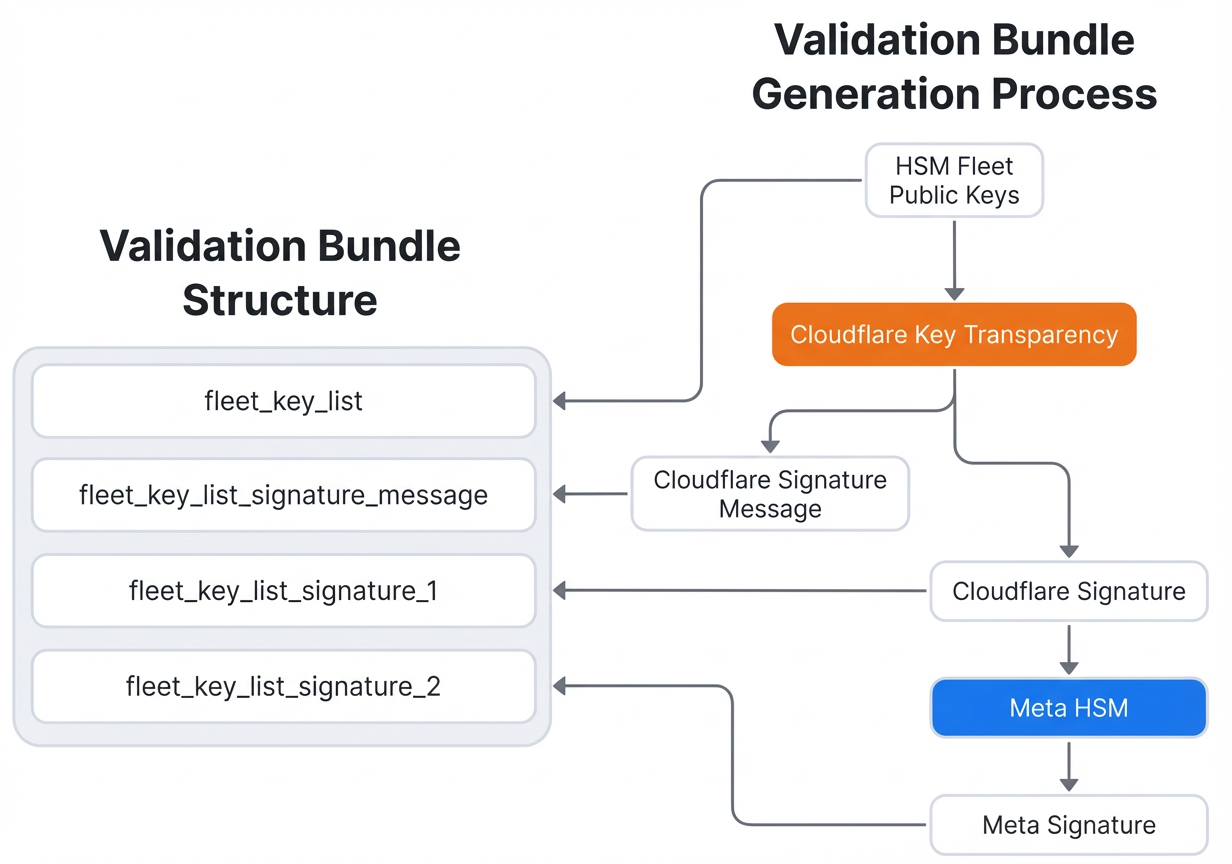
- Receive Validation Bundle: When Messenger contacts an HSM, the response includes a validation bundle containing the fleet's public keys.
- Verify Signatures: The bundle is first signed by Cloudflare (acting as an independent third party), then counter-signed by Meta. Clients verify both signatures using Cloudflare and Meta's known public keys.
- Check Audit Log: Cloudflare maintains an audit log of every validation bundle issued, providing an additional layer of transparency.
Verification Example (conceptual command line):openssl smime -verify -in validation-bundle.txt -CAfile cloudflare-root.pem | openssl smime -verify -CAfile meta-ca.pem
This confirms the bundle's authenticity and that the fleet key is legitimate.
By distributing keys over the air, Messenger can deploy new HSM fleets without waiting for app store releases, while maintaining strong cryptographic guarantees. For full protocol details, see the whitepaper (referenced later).
3. Ensuring Transparent Fleet Deployment
Meta now publishes evidence of each new HSM fleet deployment on its engineering blog. These infrequent deployments (every few years) are documented with cryptographic proofs that allow anyone to verify the fleet was set up securely. The process outlined in the whitepaper's Audit section enables independent verification.
Steps to verify a fleet deployment:
- Locate the published evidence on Meta's blog (e.g., a signed statement from the deployment ceremony).
- Obtain the fleet's public key from the evidence or from the over-the-air bundle.
- Use the verification procedure described in the whitepaper to ensure the key matches what is expected for a secure deployment.
- Compare the fleet's cryptographic attestations against the published evidence.
This transparency ensures that Meta cannot silently introduce a malicious HSM fleet to access user backups—any tampering would be detectable by the community.
Common Mistakes
- Trusting unverified fleet keys: Always verify the validation bundle's signatures against Cloudflare and Meta's known public keys. Never accept a key from an unauthenticated source.
- Ignoring audit logs: The Cloudflare audit log provides a tamper-proof record of every key distribution. Failing to cross-check allows potential replay attacks.
- Assuming hardcoded keys are permanent: While WhatsApp hardcodes keys, they can be updated via app updates. Users must update their app to receive new keys.
- Overlooking the recovery code: A strong, unique recovery code is your personal safeguard. If you forget it, the HSM cannot help—your backup is irrecoverable.
- Skipping deployment verification: The published evidence is there for a reason. If you're a security researcher, always perform the full audit as described in the whitepaper.
Summary
Meta's enhanced end-to-end encrypted backup infrastructure relies on a distributed HSM vault, over-the-air fleet key distribution, and transparent deployment practices. By verifying fleet keys through independent signatures (Cloudflare + Meta) and auditing deployment evidence, users and developers can trust that even Meta cannot access their message history. These changes represent a significant step in user privacy and demonstrate how robust cryptographic design, combined with transparency, can protect sensitive data at scale.
Related Articles
- A Comprehensive Guide to Peristaltic Pumps: Choosing the Right Design for Your Fluid Transfer Needs
- How Russian Hackers Exploited Obsolete Routers to Hijack Microsoft Office Authentication
- Understanding the V8 Sandbox: A New Step Toward Memory Safety
- Dirty Frag Exploit Puts Linux Systems at Risk of Root Takeover – Critical Threat Detected in the Wild
- Inside the Shai-Hulud Attack: A Guide to Detecting and Defending Against the Lightning PyPI Supply Chain Compromise
- 8 Critical Facts About the New xlabs_v1 Botnet Hijacking IoT Devices via ADB
- Meta Bolsters Encrypted Backup Security with New HSM Fleet Distribution and Transparency Measures
- How to Host an Engaging Online Python Conference: Lessons from Python Unplugged